
Reliable Ways to Facilitate Learning and Retention (Facilitation Friday #98)
Every facilitator needs a toolkit full of options they can confidently implement.

Think of the workshops and webinars you attended this year. What percentage included segments designed to facilitate your retention and ability to apply and share your learning?
If your answer is less than half, you’re not alone. Between 25-50% has been the consistent range of responses in my informal research.
What happened in those sessions that actually did something? It often was just a few minutes for individuals to reflect on the session and identify a few lessons to apply. Better than nothing, but still far short of what is needed and desirable.
Let’s change this. Let’s model a stronger commitment to learning and retention in our session design and facilitation
One Guiding Design Principle
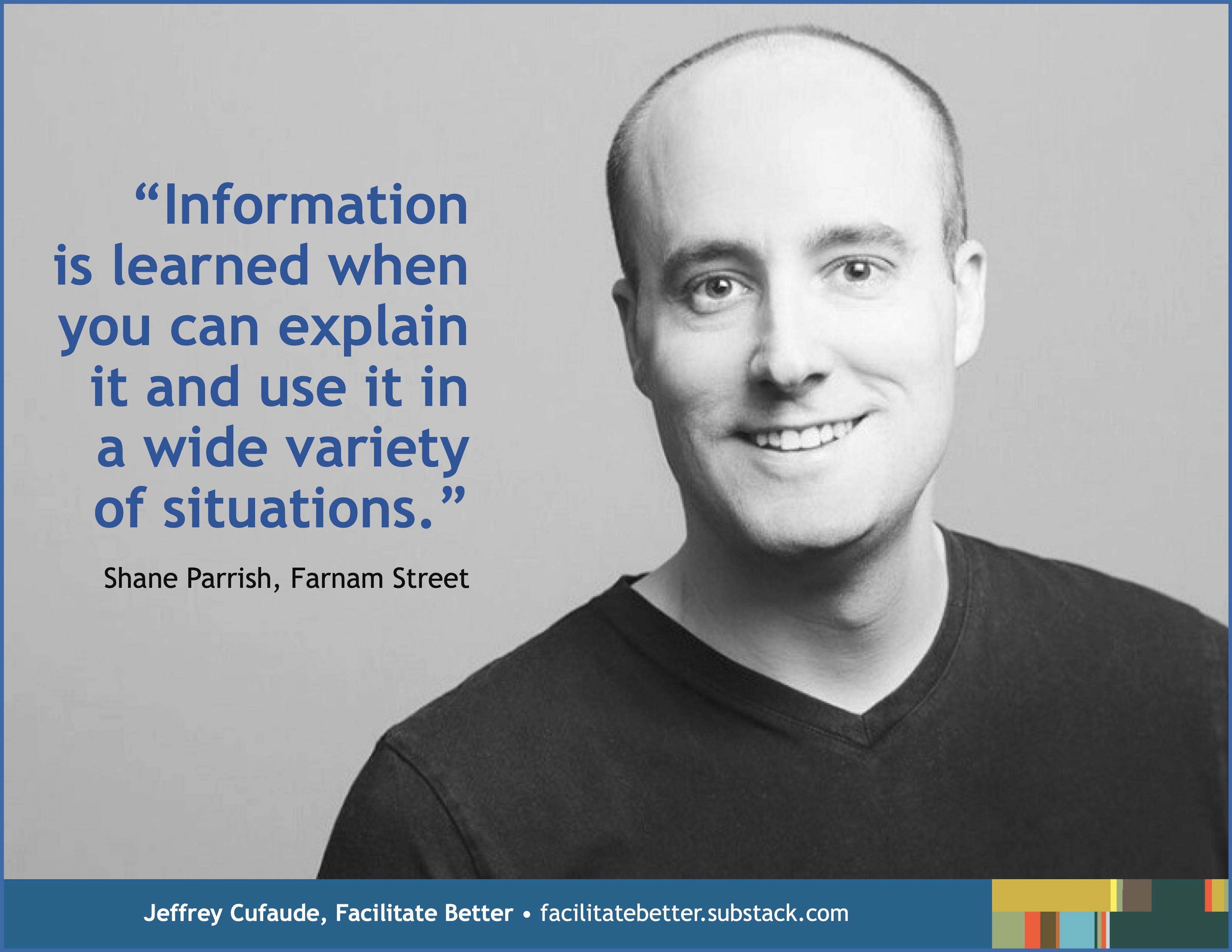
I wholeheartedly endorse this assertion from Shane Parrish, an entrepreneur, creator of the popular Farnam Street site, and author of several best-selling books on thinking and mental models. If you don’t subscribe to his free newsletter, I highly recommend it. He truly is a thought leader.
“Explain (or teach) it and use it in a variety of situations” is a highly useful design principle for learning and retention efforts. Enacting it typically engages participants in discussions and individual or group activities that:
review and reflect on the content;
distill key takeaways and highlights; and
apply and test their understanding with others.
This basic flow, as well as Parrish’s quote, echoes the spirit of Feynman’s Learning Technique (HT to Christopher Federer, a LinkedIn connection for reminding me of this). Articles, videos, and useful critiques of Feynman’s Technique abound online. The technique’s essence? Explaining or teaching something increases learning and retention.
What’s so powerful about having a guiding design principle? We can create and customize a myriad of ways to utilize it in our respective efforts.
From Principle to Practice: Getting Started
To design a learning or retention activity, first identify what your session participants’ need to be capable of explaining or teaching to others and/or using in a variety of situations. This might mirror one or more of your session outcomes. I find it usually is:
one key topic or situation from a session’s content (i.e., how to handle a disruptive participant in a meeting), or
a broader range of session content (i.e., best and worst facilitation practices).
Now brainstorm (or research and locate) possible activities to better facilitate the desired learning and retention given what you know about participants, as well as time available. Sites listed in this post can be good sources for ideas and inspiration. Remember to always prepare a backup option you can implement seamlessly.
This information also should inform the design of your collateral materials (slides, learning worksheets, et al). Slides and handouts are vital partners in facilitating learning and retention. I wish more presenters and facilitators viewed them as such and adapted their designs accordingly. We can do better than automatically defaulting to slide images as handouts.
Five Reliable Activities/Formats
I’m experimenting with announcing at the onset of a session (and/or in the advance materials) that participants’ knowledge and understanding will be assessed at some point. Some participants find this information useful; some find it a bit intimidating. I’ll continue to try different language in my explanations to enhance the former and reduce the latter.
Here are five of my favorite activities or approaches to help facilitate learning and retention. Each is easily adapted for different content and outcomes, as well as group size and other logistics.
1. Find Your Q&A Partner (20-30 minutes)
I often use this when my session content includes some right answers. It nicely engages introverts and extroverts and quickly increases energy and engagement. Here are the basics:
Determine the questions and right answers you want people to retain. Each person in your session will need one question or answer.
Print the questions on one color paper or cardstock and the answers on another. Make sure to have enough for your session attendance.
Cut up slips of questions and answers.
In the session, distribute one slip to every participant. Explain that each has either a question or answer related to the session. Note the color stock differences for the questions and the answers.
Explain they need to find their “match,” the person with the answer (or question) that corresponds to their slip. When they do, the pair should sit down together.
When they encounter someone who is not their match, each person in that pairing needs to try and guess the correct question (or answer) for the other person before they continue their search.
Announce a time limit.
Once all matches find each other, call on each Q&A pair to share their information with the group. Further debrief as desired.
2. Metaphor or Mnemonic Magic (20-30 minutes)
This is another “quick hits” technique to facilitate learning and recall.
Identify the core insights or takeaways you want participants capable of applying and recalling. Assign one to each participant. Multiple participants will have the same assignment.
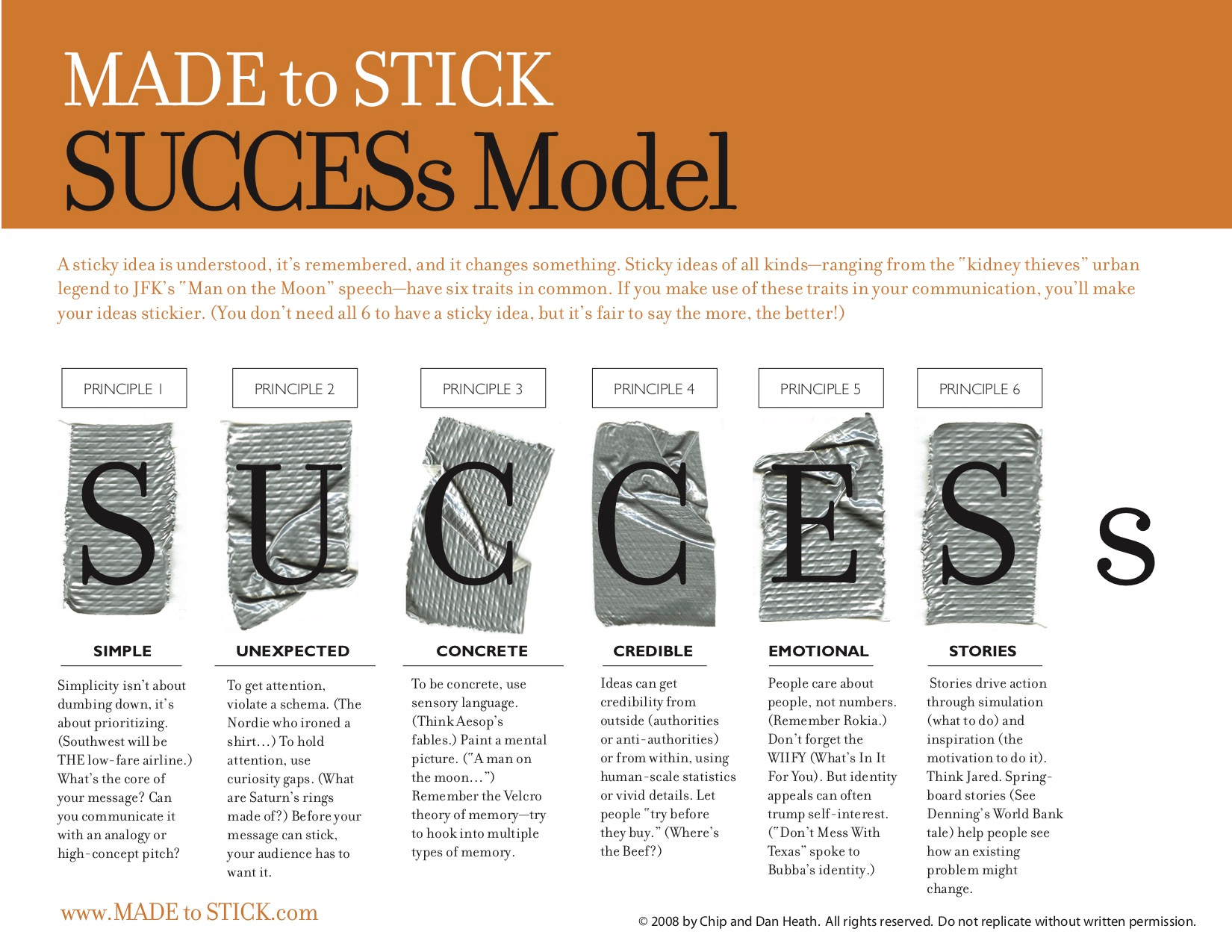
Talk for one or two minutes about the power of metaphors, analogies, and mnemonics (like the Made to Stick SUCCESs model above) to facilitate learning, application, and retention.
Ask for (or provide) an example or two of each. Invite participants to take a few minutes to silent brainstorm possible metaphors, analogies, and/or mnemonics for their assignment.
Instruct participants to join others with the same assignment. I usually post stations around the room where they can gather for a quick huddle.
Once together, individuals share their brainstorms. Groups then generate any additional ideas inspired by what they just heard. Finally, they select 2-3 favorites to share with others.
Following these group reports, debrief as desired.
3. Create a Quiz Game (30-60 minutes)
Think back to primary and secondary school. Games and quick quizzes were commonly used to facilitate learning and retention. In our “grown-up world” they often are underutilized.
Small groups of participants identify (or you provide them with) the most important content from the session. They then create a game that quizzes others’ knowledge of it. Don’t be surprised if participants draw on well-known board games or television programs (Password, The $100,000 Pyramid, and Who Wants to Be a Millionaire? are popular).
Groups swap games, play the game given to them, and offer feedback to the creators before that group does a final revision.
You can add guardrails or requirements for the games that support the session outcomes and/or align with the culture(s) of those present.
4. Both Sides (20-30 minutes)
This technique is for session learning that can be distilled into opposite categories, such as:
do this/don’t do this
before/after
effective/ineffective practices
best/worst
easy to do/difficult to do
For every 15-20 participants, you need either (1) one double-sided corkboard on wheels and index cards, pushpins, and markers or (2) a pair of flipcharts on easels positioned back to back and markers.
Label the sides of each corkboard or flipchart pair with the opposite categories you’ve selected.
Invite 7-10 participants (self-selected or as you assign) to gather on each side. Announce the topic and the opposites, i.e., effective facilitation practices, ineffective facilitation practices.
Groups brainstorm and legibly post responses for the topic and their side for 5 minutes.
Participants then literally switch sides/locations, cast votes for their favorites of what the other group posted, and then add their own thinking.
Groups return to their original sides, review the feedback and additions, and then assemble a final list of a prescribed number of offerings.
Post final lists for a brief “gallery walk,” followed by debrief as desired.
5. Creative Connections (30-60 minutes)
When appropriate, I love to engage participants in more open-ended and creative ways to help them explore how to explain and teach content to others.
The following examples work well when you want participants to distill content and identify key takeaways:
create a magazine cover and table of content with article titles
produce a five-minute “newscast” with top stories
develop a few TikTok videos
generate an ad campaign with a recurring slogan
create one or more radio commercials
produce a skit
write a Schoolhouse Rock-style song
Since these approaches are fairly self-explanatory, I won’t detail each one. Note that as with any of the four other approaches, you can supply parameters that focus the activity to meet your needs.
Bottom Line
Great content that is quickly or easily forgotten serves no one. Participants explaining or teaching it to others helps increase their understanding and facilitates retention. Effective presenters and facilitators ensure their session design and facilitation includes activities that make this easier.
Getting in Action
Other than activities like those mentioned, what else helps facilitate your learning and retention in workshops and webinars? How might you do something comparable in your own efforts?
How might you incorporate one or more of the five activities in the sessions you facilitate?
Find at least two other activities or approaches via your own online sleuthing or using one of the resources mentioned in this post.
© Facilitate Better and Jeffrey Cufaude. All rights reserved.
To affordably license this content for reprint on your site or in electronic or print communications or to contact me regarding customized facilitation skills workshops or consultations, complete this form.