
Reliable Resources to Make Session Design and Facilitation Easier (Facilitation Friday #92)
These easy-to-use resources save you time and help produce better results.

Facilitation workshop participants always ask what resources I use for my meeting and workshop design and facilitation. This post highlights six reliable resources I turn to regularly for tools, techniques, methods, and formats:
Methods Library • International Association of Facilitators
Participatory Methods Library
Liberating Structures
Grove Visual Planning Templates
Stanford dSchool Design Thinking Bootleg
Cvent Event Diagramming (requires free registration)
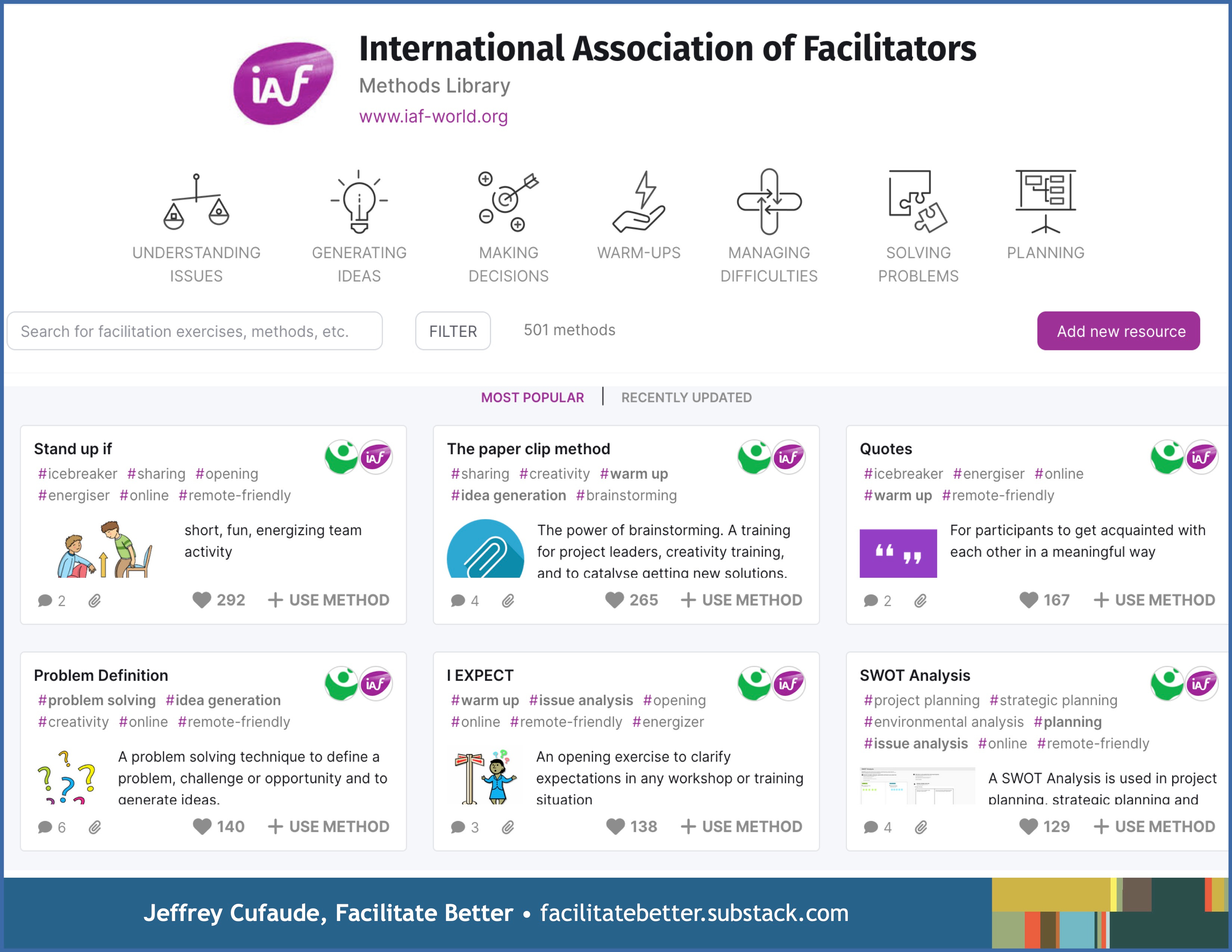
Methods Library • International Association of Facilitators
IAF is the primary professional association for all things facilitation, and its Methods Library is one of the best resources it offers. Hundreds of methods are available. Each is tagged to make it easier to find the ones most relevant to your needs. Some are restricted to members only, but a healthy percentage are public.
A method typically outlines its goal, length of time required, number of participants for which it is appropriate, and instructions for using the method or conducting the activity. Support materials like a graphic, worksheet, or slide often also are included.
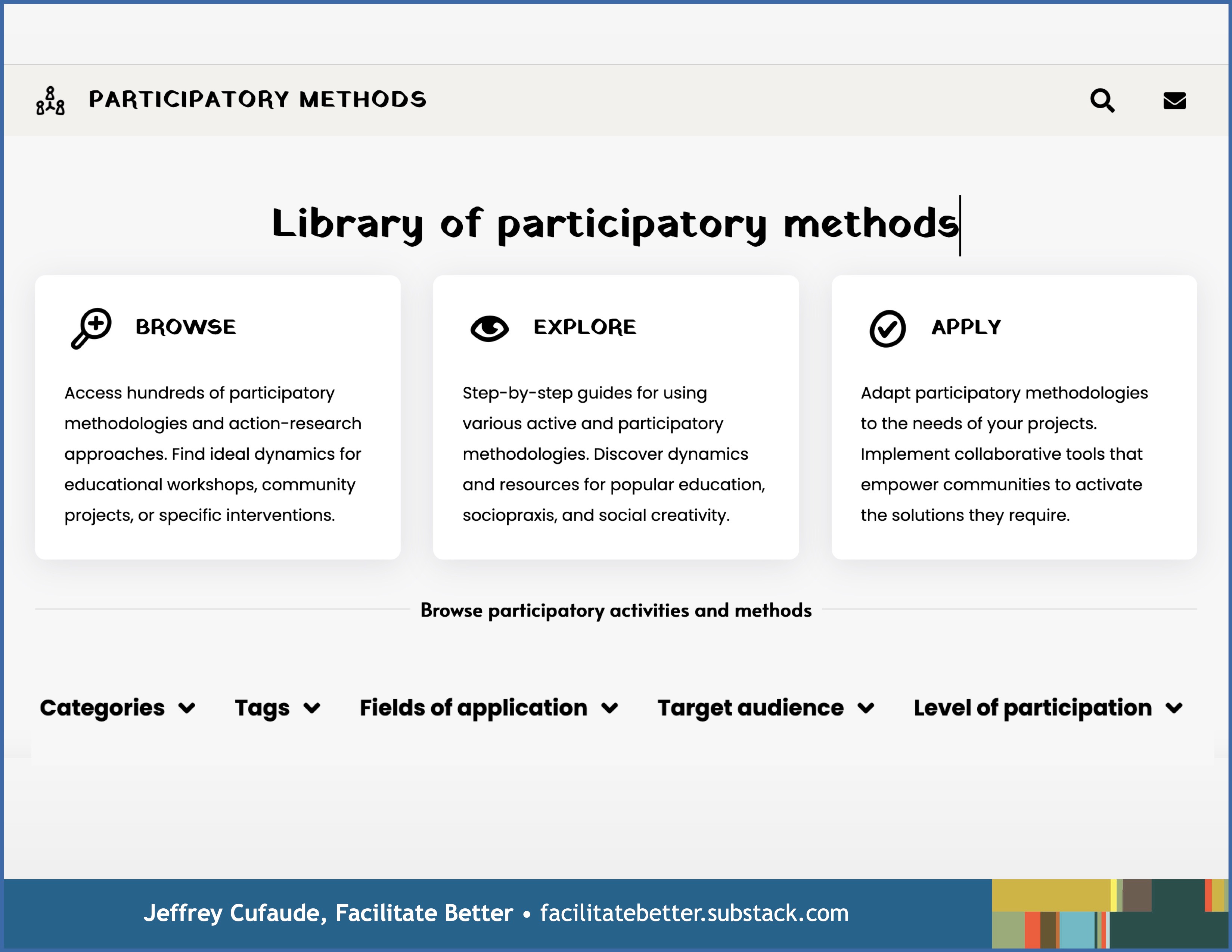
Participatory Methods Library
“Participatory methodologies promote active collaboration, dialogue, and the inclusion of everyone involved in decision-making, learning, or community development processes. They aim to empower participants, foster co-creation, and generate sustainable solutions tailored to real needs” (from the site description).
Similar to the IAF Methods Library, here you’ll find a variety of searchable tools, techniques, and engagement formats … all free to view. While the IAF site caters most to meeting and workshop facilitators, this resource is a bit broader and more generalist in its offerings.
Each method typically highlights purpose, tags for type of activity, level of participation, target audience, estimated duration, and ideal number of participants.
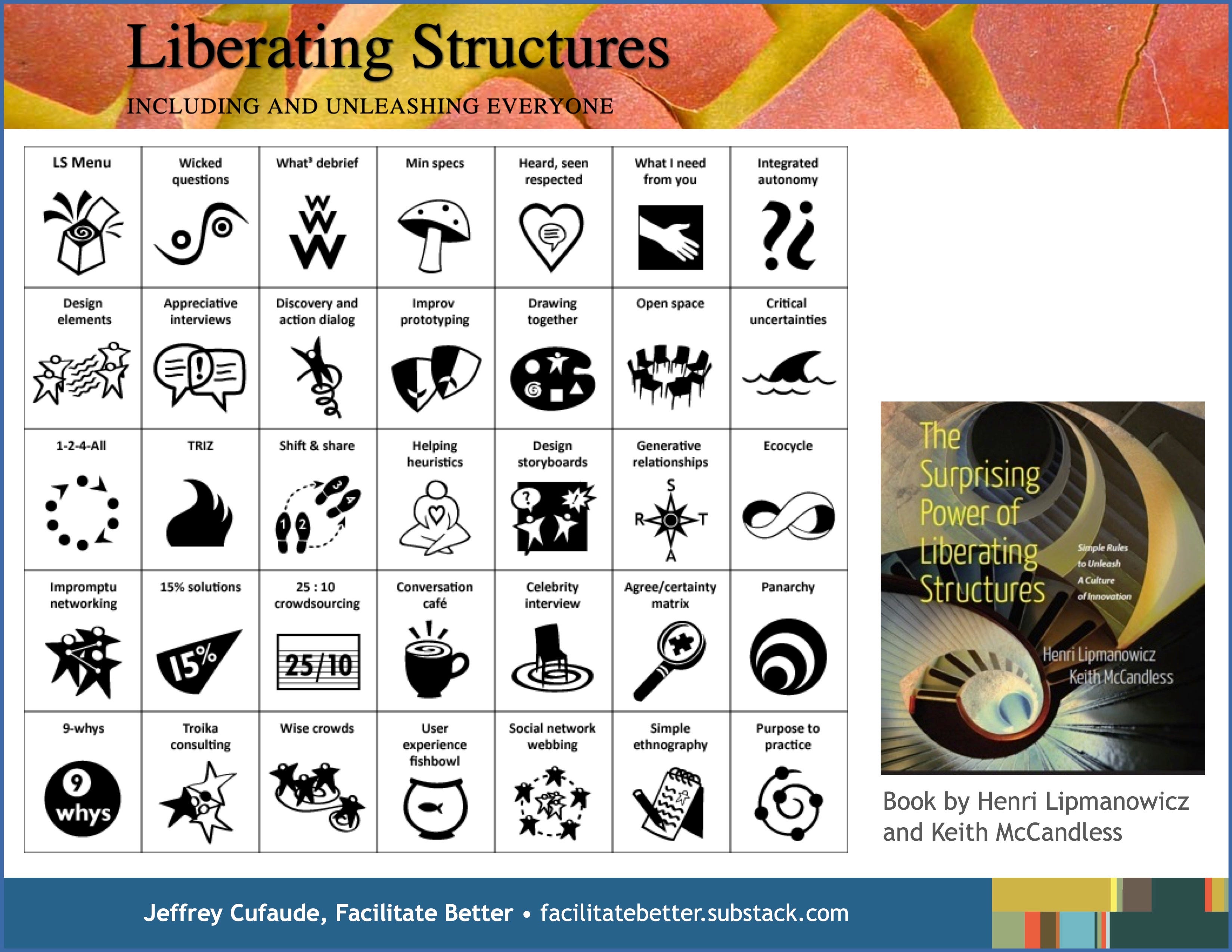
Liberating Structures
Liberating Structures is both a book and a site. Both provide “an alternative way to approach and design how people work together…. Liberating Structures used routinely make it possible to build the kind of organization that everybody wants. They are designed to include everyone in shaping next steps.”
For each of the 33 Liberating Structures, you’ll find all the relevant information needed to incorporate them in your meeting or workshop design and facilitation. Typical information includes: overview and purpose of the structure/format, facilitation guidance, space and materials needed, tips and traps, and riffs and variations.
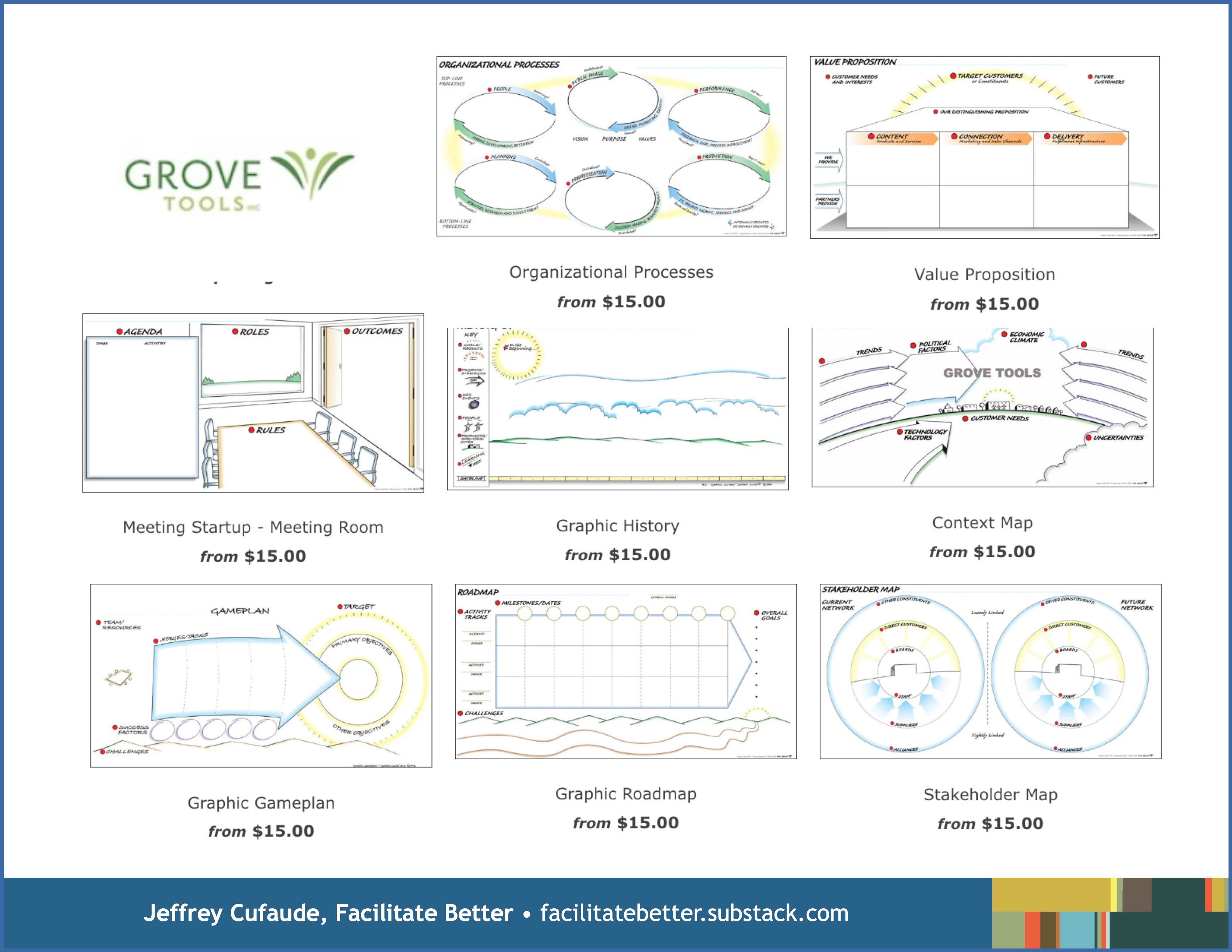
Grove Visual Planning Templates
These affordable professional designed templates are available in a variety of sizes ranging from individual worksheets to huge wall-sized posters. Each provides a more visual means to guide discussions and capture information from them.
I find clients often scan or capture images of completed templates for subsequent communications or reports and for social sharing. The Grove templates also are good inspiration if you want to design your own templates for common meeting or workshop activities. Here is a two-minute demo showing how the Context Map can be used.
Template topics include:
Stakeholder Map
Industry Structure Map
SPOT Matrix
Meeting Startup
Context Map
Cover Story Vision (one of my faves)
Journey Vision
Value Proposition
Grove offers lots of other facilitation resources (I love their markers), so I encourage you to browse their site.
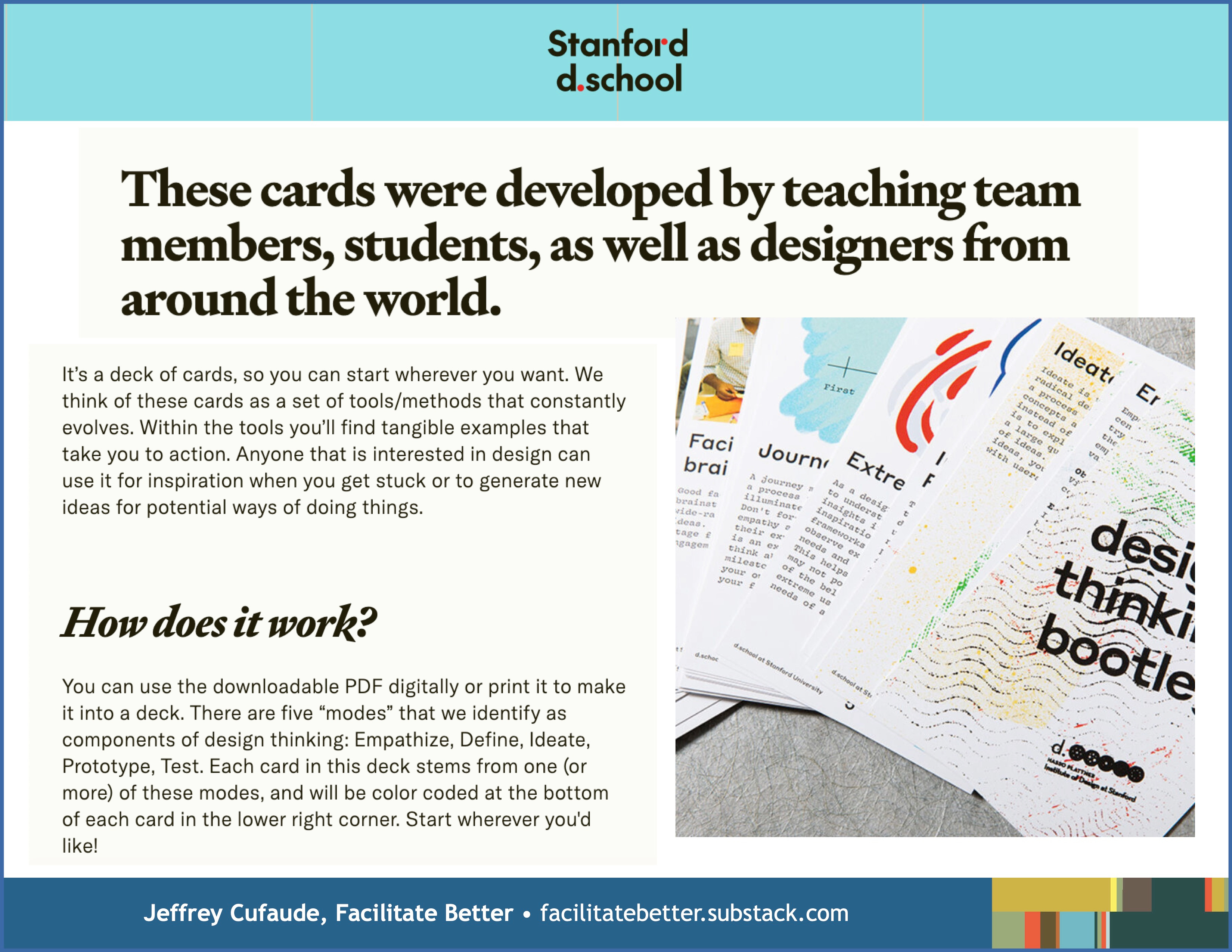
Stanford d.school Design Thinking Bootleg
Card decks remain a popular facilitation tool format. The classic d.school Bootleg deck contains dozens of tools and activities connected to one of the five modes of design thinking: empathize, define, ideate, prototype, or test.
The modes and corresponding activities are effective for anything that needs designing: strategies, products or services, communications, organizational culture, awards and recognition … or, wait for it … meetings, workshops, and other learning experiences.
I often play with Bootleg exercises to stimulate my session design efforts. I also use them with any individuals or committees helping with a session design, as well as with design efforts of groups I’m facilitating.
The Bootleg comes in a free downloadable card deck PDF that you can use digitally or print out.
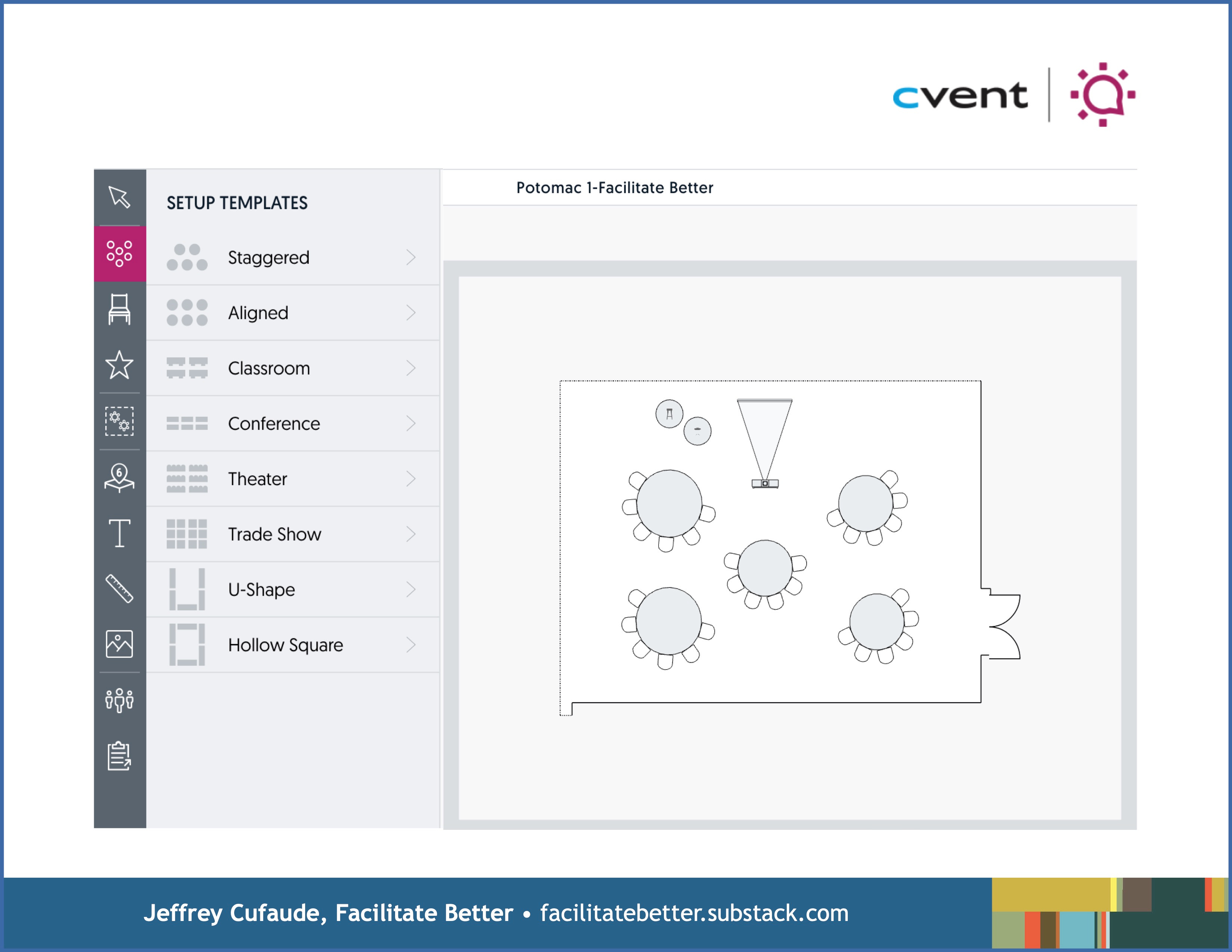
Cvent Event Diagramming (requires free registration)
This free event planning platform saves me hours in drafting room layouts that I can use with clients and facility staff to make sure the meeting or workshop environment meets my needs. It took only minutes to create the room layout above for an upcoming workshop. You can pull actual room diagrams (as I did from the hotel for my session) for more than 1000 properties.
You can get into the details and specify quite a few dimensions for various room elements. While meeting standards exist for about every choice you might make, don’t worry if you don’t know them. Whatever layout you draft will have more precision than any specs you might communicate in a text document. Use your layout as a starting point for discussion and refinement.
The site may seem intimidating at first, but it is incredibly intuitive. Approach it with a “playing in a sandbox” mentality and just start trying things out. Soon you’ll quickly be adding crescent tables, AV equipment, and food and beverage stations into a draft layout.
Bottom Line
When it comes to meeting, workshop, or conference design and facilitation, you’re never on your own. Reliable resources abound to help you make your efforts more purposeful and engaging, which in turn, should help produce better results.
Getting in Action
Think of a meeting or workshop you facilitate and how changing (or adding) an activity, format, or participation method might improve it. Identify 2-3 possibilities from one or more of the resources highlighted.
Use the Cvent Event Diagramming site to experiment with designing potential room sets for a 25-person strategic planning session.
Identify a Grove Visual Planning Template that would be valuable in your meeting or workshop facilitation and/or do a rough design of a useful template of your own.
© Facilitate Better and Jeffrey Cufaude. All rights reserved.
To affordably license this content for reprint on your site or in electronic or print communications or to contact me regarding customized facilitation skills workshops or consultations, complete this form.