
Panel Design and Facilitation for Better Engagement and Value (Facilitation Friday #95)
Panels deliver more value when participants engage with expertise, not just listen to experts.

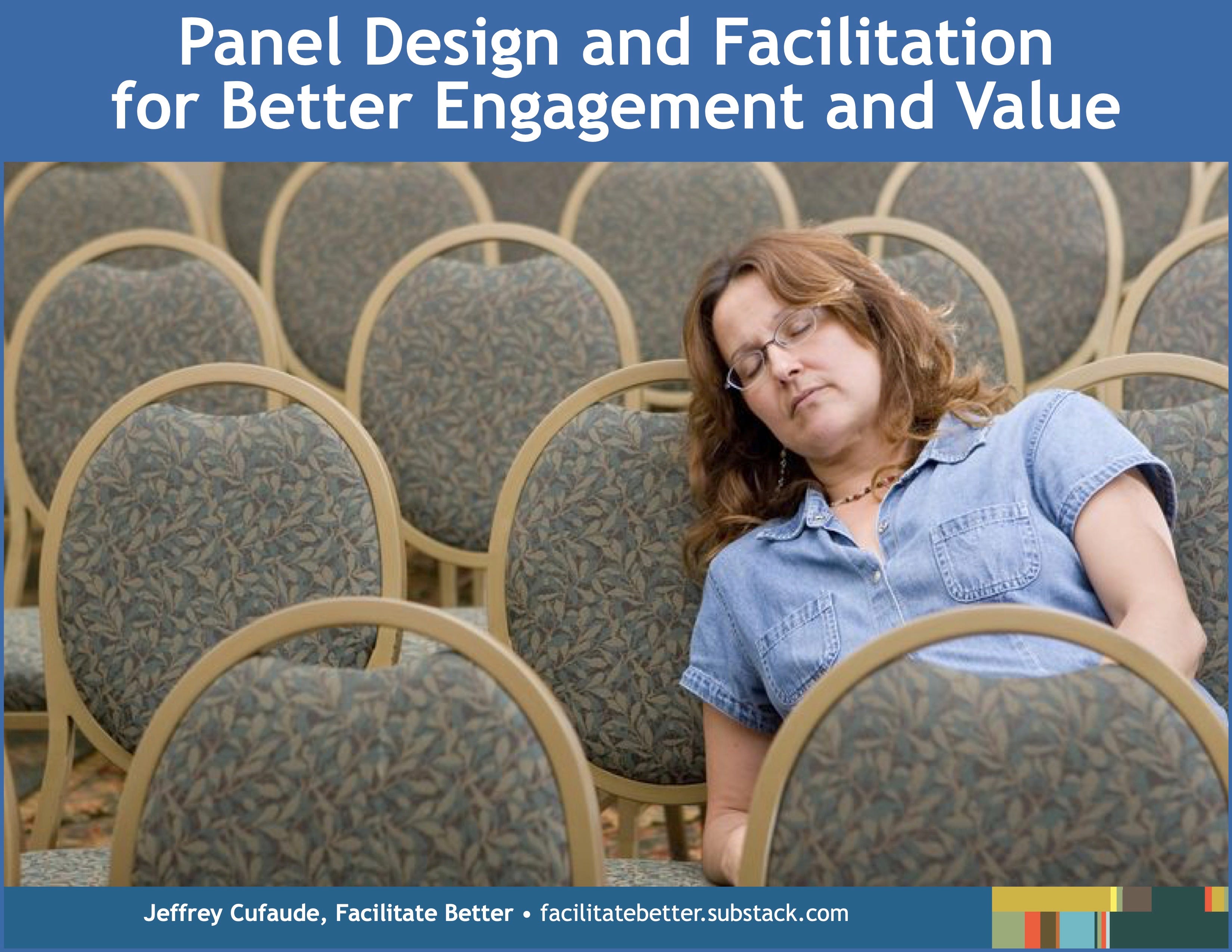
A recent conference panel discussion left me shaking my head in disappointment. The weak format and traditional room setup constrained interesting speakers.
Problem with panels are well-known, but still pervasive. Participants want concentrated insight, contrasting perspectives, and dynamic conversation … not slow, one-at-a-time commentary. Even with skilled moderators and facilitation, panels fall flat if the format and environment suppress interaction.
The Typical Panel Problem
Panel marketing typically promotes the topic and speaker bios. The initial 20% of the session is often burned rehashing the same information.
The uninspired format then continues with a moderator question followed by panelists answering (often at great length). Repeat ad nauseam. The session ends with a short participant Q&A that may get to only a few queries.
Sit through 60 minutes of that and you’re lucky to leave with two useful insights. That’s not good enough.
Here are six key opportunities to rethink and refresh panel design and facilitation for better learning and engagement. Whatever decisions you make, be sure to carefully socialize panelists to the experience you’re trying to create and the support and contributions it asks of them.
Opportunity #1: Experiment with Alternative Room Sets
Avoid placing panelists in a static line. Experiment with novel formats such as:
Fishbowl seating with a few chairs amid panelists for rotating audience participation.
Runway-style movement so panelists engage the whole room.
House of Commons layout with opposing sides and surrounded audience.
Panelist Soapbox Stations around the room that attendees roam among freely, engaging with panelists as desired.
Belly Up to the Bar with panelists seated on barstools or standing at the “bar.” Bar = two tables angled to slightly face each other.
Nowhere is it written that panelists must be seated in one manner for the entire session. Change their positions to change the type, tone, and pace of the conversation; i.e. standing for a closing lightning round, offering a final provocation while standing among the audience, et al.
Opportunity #2: Seed the Conversation Before the Event
Share panelists’ key ideas, predictions, questions, et al, in the event marketing, not just their job titles. When possible, offer an advance “panel preview” (short video, executive summary slide, short blog post, etc.) so attendees arrive already thinking, reacting, and ready to engage. Consider ideas I shared in this post on workshop previews.
Opportunity #3: Jumpstart Engagement with Concentrated Content
Orange juice concentrate comes in a small container that the water you add expands rapidly. Similarly, powerful panels introduce concentrated content that expands through thoughtful conversation.
Aim to rapidly fill the room with panelists’ perspectives and provocations using no more than 25-30% of the total available time. Panelists could do fast-format presentations (i.e., PechaKucha or Ignite) to get all their ideas out quickly or use a template you provide.
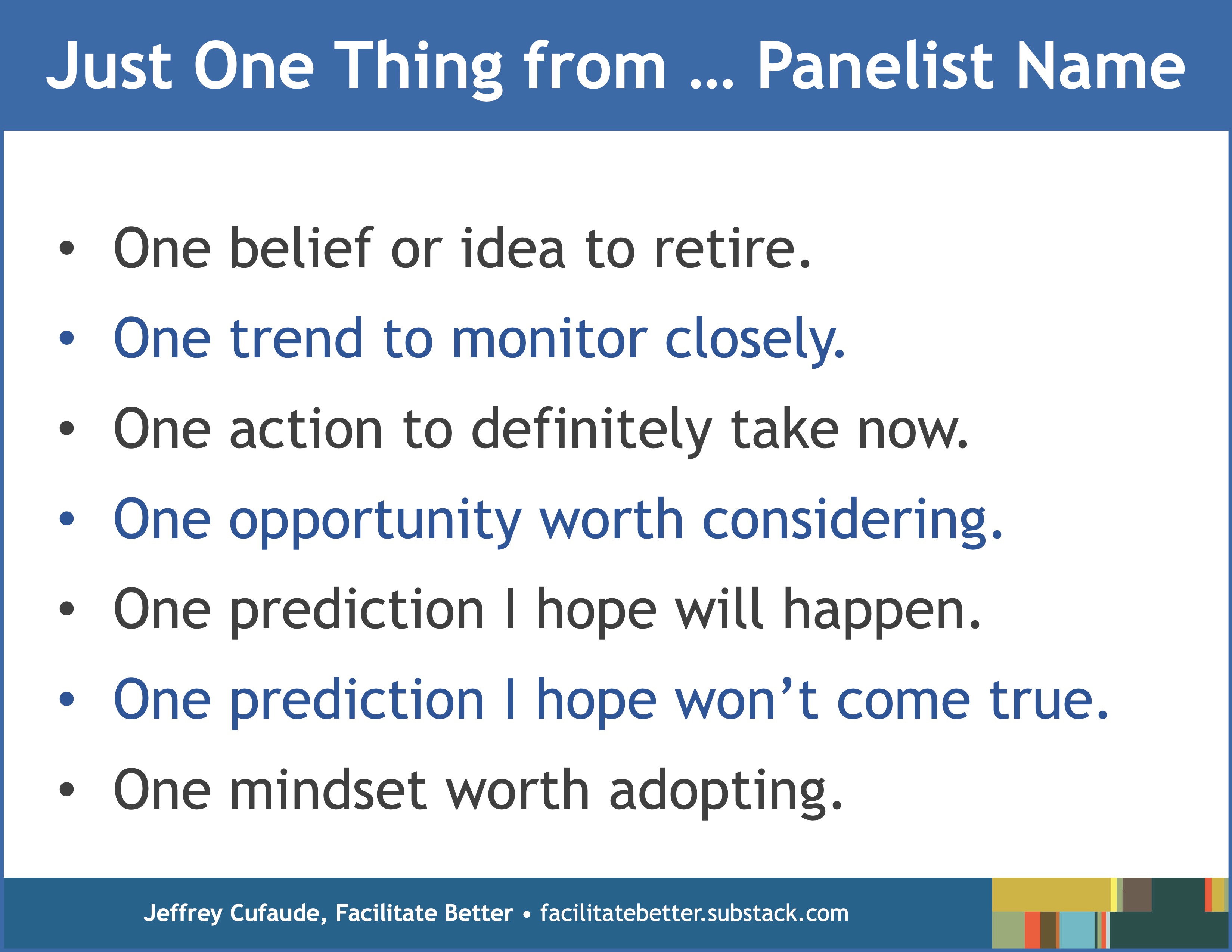
I sometimes give panelists 7-10 Just One Thing prompts like those below and ask them to select three for a brief presentation. Panelists open the session speaking for 3-5 minutes about their choices while a bio and summary slide displays.
Opportunity #4: Leverage Participants’ Perspectives
Use index cards to collect questions upon participant arrival or solicit them in advance via social channels or on the registration form.
Select a representative sampling to launch an expanded block of Q&A during the session and/or draw on them to pose relevant questions in response to panelists’ remarks.
Consider flipping the format. Ask questions of those in attendance and then invite panelists to react to their responses.
Opportunity #5: Assertively Facilitate
While I generally advocate facilitating with restraint, that is less helpful when moderating panels. Embrace the improvisational spirit of a jazz ensemble, but assert the authority of an orchestra conductor as needed. Cue your musicians (the panelists) for what you need from them while you manage the overall experience and its tone and volume.
Panel discussions quite often suck the energy from the room because of labored comments and slow pacing. Drive a more engaging and energizing experience through intentional use of (1) your voice and (2) your physical presence.
Be willing to:
ask for clipped responses to some questions … “summarize your position in ten words or less.”
politely interrupt or cut off panelists (inform them in advance how you will do so)
invite quick reactions from the audience … “raise your hand if that sounds right to you.”
Opportunity #6: Rekindle Content and Conversation at Closing
Distill the content and conversation in a manner that will rekindle participants’ interest and attention and send them off still talking with each other. Four closing options I find work well:
Use 5-10 of the solicited questions for a final “lightning round” of quick queries and rapid responses.
Poll the audience to surface insights likely to further stimulate conversation.
Have participants write a hunch or action item inspired by the session on a large index card. Post them on a wall for casual browsing as the session concludes or do a rapid “read and pass” exchange of cards for 2-3 minutes.
Ask panelists to share (1) one critical question for further exploration and (2) one action item that absolutely must be done.
Bottom Line
Panels deliver more value when participants engage with expertise, not just listen to experts. Rethinking and refreshing panel design and facilitation helps ensure more energizing, high-value conversations instead of predictable, passive programs.
Getting in Action
Think of the best panel discussion you’ve experienced. What made that session worthwhile? How might you adopt or adapt those elements in your own efforts?
Brainstorm at least five additional “Just One Thing” prompts you might offer to guide panelists’ remarks.
How else might you close a panel discussion to best stimulate participant reflection and action?
© Facilitate Better and Jeffrey Cufaude. All rights reserved.
To affordably license this content for reprint on your site or in electronic or print communications or to contact me regarding customized facilitation skills workshops or consultations, complete this form.
Very good points, and I love the picture. Some of us are often at the mercy of room setups that we can't control. Was on a national panel this summer and it was everything you would have hated. Sitting in a line, one by one presentations, and a revered and senior person who just would not stop talking. I was last, so I at least stepped away from the podium and tried to generate a little energy in the room. That's all we can do sometimes, but I love your ideas for the times we can do it the way we want to do it! Thanks for the "one idea" idea...love it.