
Beyond Reasonable Doubt: Bad Icebreakers are a Problem (Facilitation Friday #110)
When bad icebreakers hurt morale, everyone pays eventually.

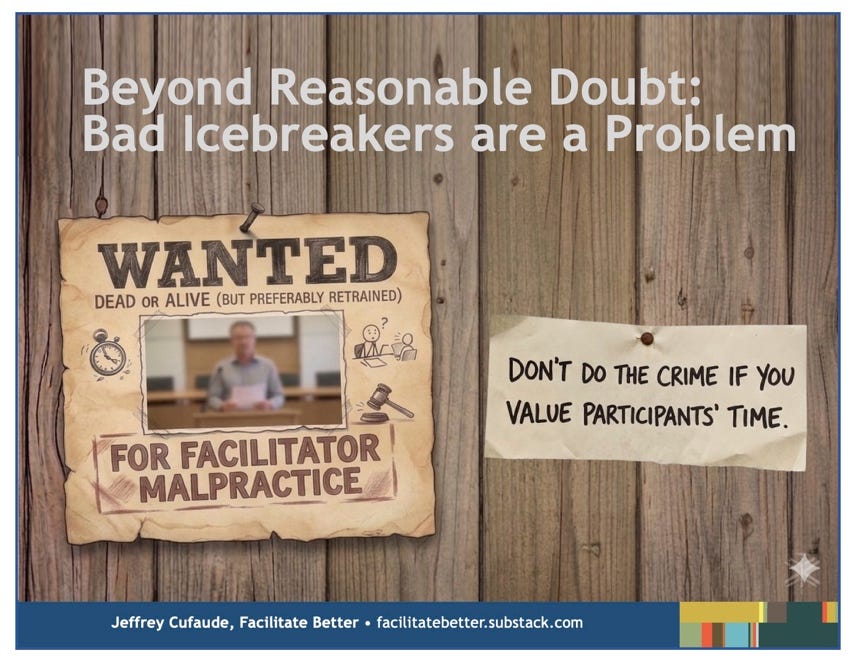
THE CRIME: favoring process over purpose.
Our presenter gushed about the icebreaker he used to start the workshop. By the end of the somewhat excruciating 20-minute exercise, not many shared his enthusiasm.
Icebreakers are a means to an important end: making it easier for participants to meaningfully engage. Forgetting this truth, our workshop leader had become obsessed with the icebreaker itself. He clearly used it regularly, regardless of the group or context.
An icebreaker with no clear purpose. A WHAT in search of a WHY. Somewhere, Simon Sinek is waving his Golden Circle for this facilitator to see.
You can’t blame people for groaning at the mere mention of icebreakers after experiencing poorly chosen, awkwardly facilitated, or inadequately debriefed activities. Without meaningful connection or relevant context, an activity doesn’t deliver much value.
How to Stay Out of Jail
Looking to avoid this in your own efforts? Answer this important facilitation question when contemplating icebreakers or warm-up activities for a gathering:
Given the work to be done, the people who will do it, and the time available, what interpersonal and/or content-related ice needs breaking?
This is the critical WHY question that too often goes unasked and unanswered. Let’s unpack its three major elements:
The work to be done: different work requires different understanding of content and context in order to be completed. Example: A strategic planning session, an onboarding retreat, a new program development meeting, and a budget review session all have different content-related ice to consider breaking.
For an example of content-related icebreaking, read this post: Equip Participants to be Better Strategic Thinkers.
The people who will do it: different groups of participants require different interpersonal familiarity and trust levels to do their work. Example: relationship considerations for a workshop presented within an organization will differ from the same workshop presented at a conference. The same icebreaker could land differently and may not be the best choice.
The time available: rushing an activity rarely works and cheating the debrief is itself a crime. Choose an option that lives within the time available, as well as any other logistical constraints.
Finally, beware of falling under the spell of Format Fetish, another felony often committed by meeting or workshop leaders. She is a mighty and dangerous Siren, tempting facilitators to overuse a favorite format instead of considering its potential relevance for—and resonance with—participants.
Don’t Push the Outcome
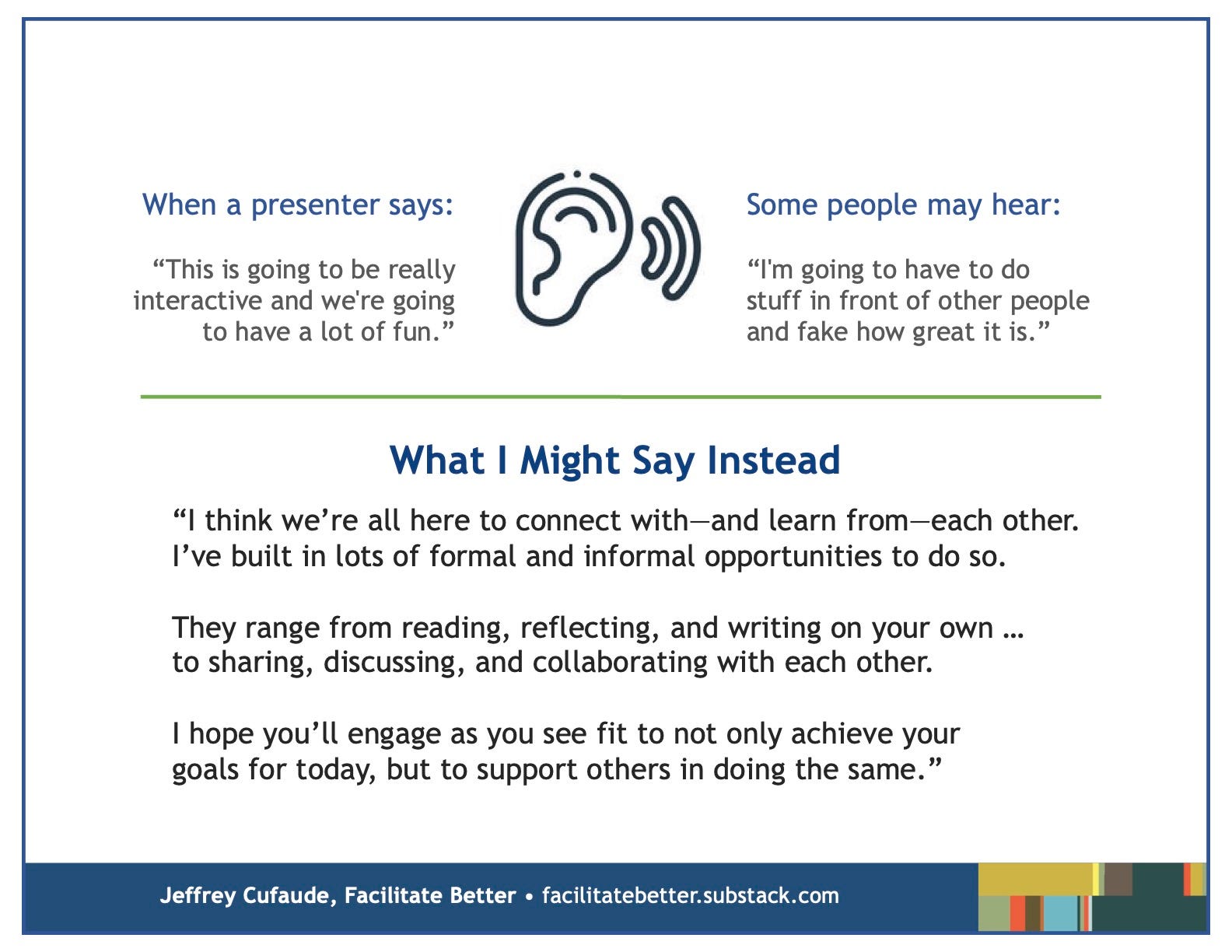
Even well-chosen icebreakers lose impact when facilitators frame them poorly, as shown above.
The value of a well-chosen activity should be experienced by participants, not sold by presenters. Let them discover it on their own.
BONUS IDEA
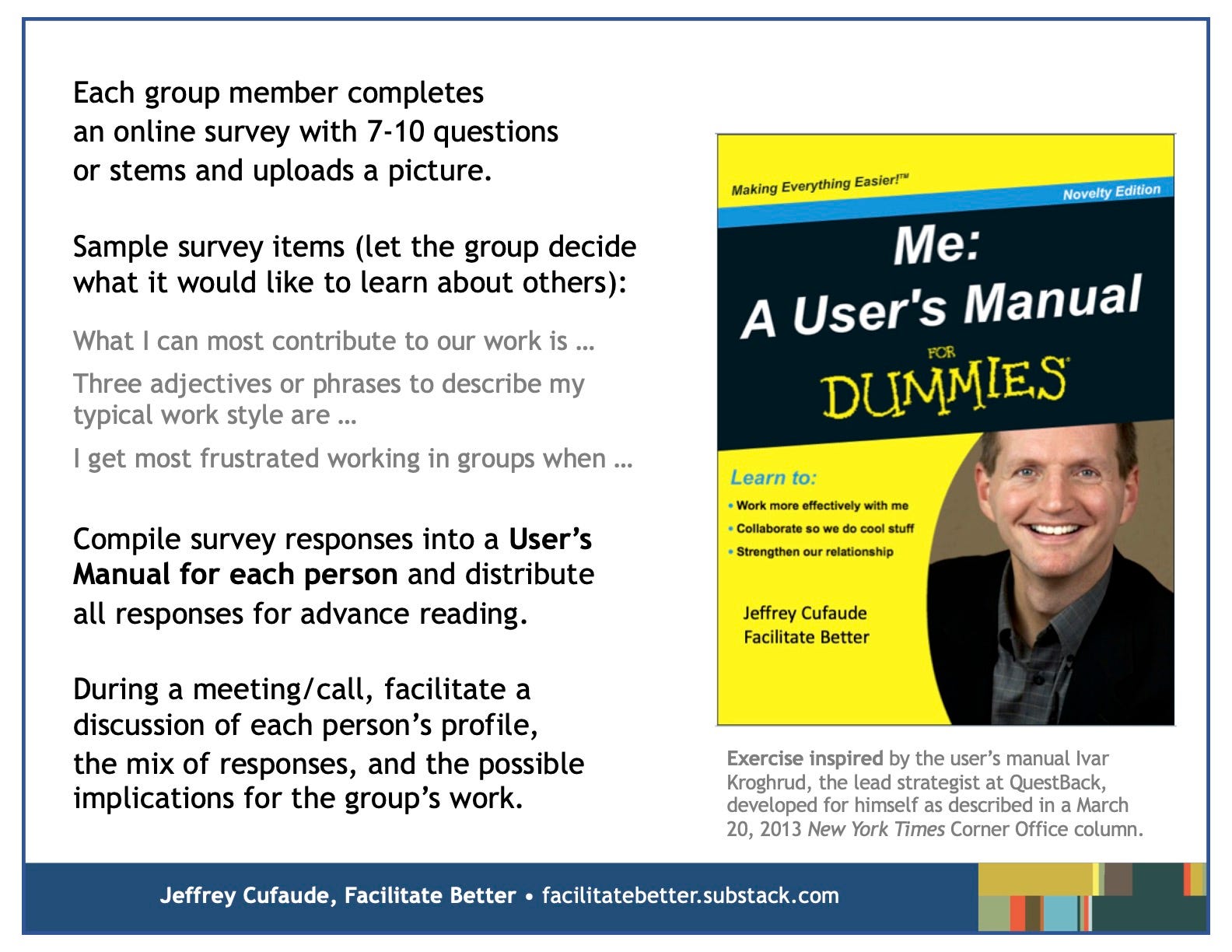
User Manuals are a popular activity to spark meaningful conversation and deepen understanding about other members of a team or work group. This PDF from Northwestern University provides a basic explanation of the activity and how to use it, as well as sample worksheets you can use for people to generate their manual.
I find the User Manual activity most effective when group members identify the manual prompts or questions for everyone to complete. To collect ideas, I ask: Given the work you will be doing together, what information about others might help you work together most effectively? I draw from the responses to create the instructions for the activity.
You can find ample suggested questions for the activity via a search online if that is not an option for you.
Bottom line?
When created or chosen purposefully, activities like icebreakers or warm-ups, as well as curated advance materials, et al, can make it easier for individuals to get things done together.
Focus first on the ice that needs breaking, not the activity you’ll use. Don’t let your activity be a WHAT in search of a WHY.
Getting in Action
Think of an activity you commonly use (icebreaker or otherwise). Clarify its purpose and potential, then assess your most recent use against that purpose. How effective was your implementation?
Identify an upcoming meeting or workshop you’ll attend or facilitate. Based on its purpose and likely outcomes, answer the most important facilitation question from this essay.
Consider “content-related ice.” What curated pre-work or one to two warm-up questions could you send 48–72 hours in advance to start engagement early?
Breaking the Ice begets Priming the Work
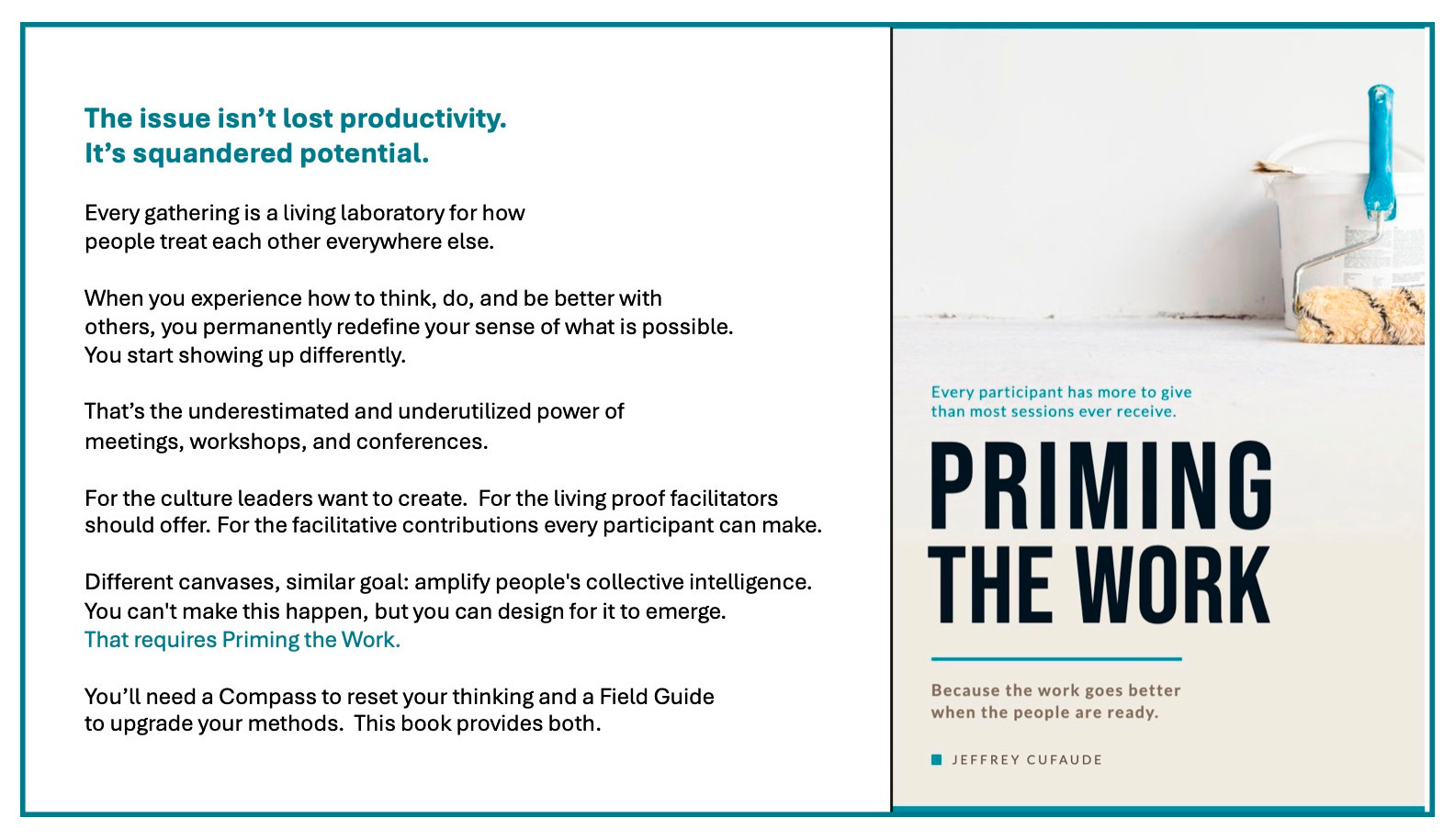
Being repeatedly victimized in this manner was the original impetus years ago to write a short manifesto on “Beyond Icebreakers.” That initial kindling recently has sparked a much more comprehensive book project focusing on leadership, facilitation, and events as change agents, currently called Priming the Work. I’ll be judicious in providing an update here on its progress. I hope the brief teaser above piques your curiosity for more.
© Facilitate Better and Jeffrey Cufaude. All rights reserved.
To affordably license this content for reprint on your site or in electronic or print communications or to contact me regarding customized facilitation skills workshops or consultations, complete this form.